
Imam Masjid Registration Phase 2
Imam Masjid Registration Phase 2 Punjab government has formally decided to launch Phase 2 of the Imam Masjid registration and stipend program, a move that comes after widespread feedback from across the province. During field reporting and conversations with local mosque committees, it became clear that many Imams were unintentionally left out in the first phase. Some mosques were not surveyed on time, while others lacked formal paperwork despite being active for years. This second phase is meant to correct those gaps and ensure that every deserving Imam gets a fair chance.
This initiative is not just about financial support; it is about recognition of religious service. By reopening the registration process, the government has acknowledged the realities on the ground and the administrative challenges faced by Imams, especially in rural and semi-urban areas of Punjab.
You Can Also Read: BISP Biometric Issue Resolved: Facial Recognition
Why the Punjab Government Started Phase 2
Phase 2 has been launched to address the exclusions and complaints that surfaced after Phase 1. Officials realized that relying only on initial surveys and limited records was not enough to cover the vast number of mosques operating across Punjab. Many Imams were serving regularly but had no access to proper guidance or digital platforms during the first phase.
Another major reason is transparency. With improved verification systems and better coordination between departments, Phase 2 aims to create a cleaner database. This helps the government ensure that the stipend reaches the right individuals without favoritism or procedural injustice.
You Can Also Read: Gold Price In Pakistan Per Tola Today
Eligible Imams and Mosques Under Phase 2
This phase is meant specifically for those who were left out earlier, regardless of the reason. From my observations, most applicants fall into this category due to documentation delays rather than ineligibility.
Phase 2 is suitable for:
- Imams who could not register in Phase 1
- Mosques that were not included in the initial data collection
- Imams whose applications were incomplete or rejected earlier
- Private or locally recognized mosques without formal registration
The focus is on current service, local recognition, and merit rather than paperwork alone.
You Can Also Read: Green Credit Program 2026 Register Now and Win Up to 1 Lakh
Role of Deputy Commissioner Offices
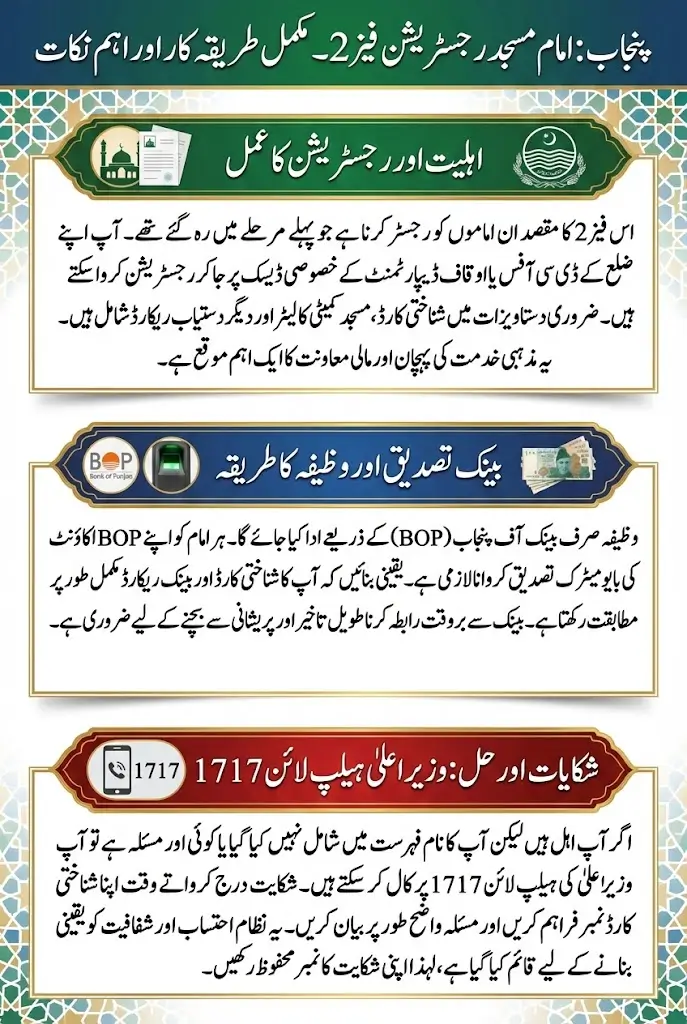
The Deputy Commissioner (DC) offices have been given a central role in this phase. District administrations are now actively collecting fresh data of mosques and Imams who were missed earlier. Special desks have been set up in many districts to handle these registrations, reducing confusion and unnecessary movement between offices.
From what has been seen on the ground, DC offices are coordinating with multiple departments to ensure that data is collected systematically. Applicants are advised to approach these offices directly instead of relying on unofficial sources.
You Can Also Read: PAVE Scheme Electric Bikes and Rickshaws 2026
Support and Facilitation by Auqaf Department
The Auqaf Department is working alongside district administrations to guide applicants. Dedicated counters have been established to help Imams understand the procedure, required documents, and verification steps. This is especially helpful for elderly Imams who may not be familiar with online systems.
The department also plays an advisory role, ensuring that religious service records and mosque recognition are properly assessed before forwarding cases for final approval.
You Can Also Read: BISP 8171 Result Check By CNIC For 13500 Payment
Re-Registration Process Explained Clearly
Re-registration under Phase 2 means submitting your information afresh so that updated and verified records can be created. This process is simpler than it sounds but requires honesty and attention to detail. Applicants must ensure that all information matches official documents.
The re-registration process generally includes:
- Visiting the DC Office or Auqaf Department desk
- Submitting Imam and mosque details
- Attaching available supporting documents
- Waiting for verification by district committees
Providing incorrect or misleading information can result in delays or rejection.
You Can Also Read: Shab E Barat 2026 Date In Pakistan – Night of Mid Shaban
Documents Required for Phase 2 Registration
Document requirements have been kept flexible to accommodate real-life conditions. While some documents are mandatory, others are optional if not available.
| Document | Requirement Status | Purpose |
|---|---|---|
| Imam’s CNIC | Mandatory | Identity verification |
| Madrasa Certificate | Optional | Educational background |
| Mosque Registration Proof | Optional | Legal record of mosque |
| Mosque Committee Letter | Mandatory | Local confirmation |
Applicants should submit whatever documents they have, as verification committees also rely on local recognition.
You Can Also Read: Silver Rate Today In Pakistan – 1 Tola Chandi Price
PITB Online Portal and Mobile App Initiative
To improve transparency and reduce manual handling, the Punjab Information Technology Board (PITB) is developing a dedicated online portal and mobile app. This system will allow remaining Imams to upload their information directly without repeated office visits.
The digital system aims to:
- Reduce human error
- Speed up verification
- Allow applicants to track progress
- Protect applicants’ rights
This step is expected to improve trust in the overall process.
You Can Also Read: Xiaomi 18 Hardware Features Surface in New Leak
District Verification Committees and Their Role
Each application submitted under Phase 2 is reviewed by a district-level verification committee. This multi-member committee ensures that decisions are not made by a single authority.
The committee verifies:
- Authenticity of the Imam
- Local recognition of the mosque
- Accuracy of submitted information
- Security clearance where required
This layered verification protects the program from misuse.
You Can Also Read: New PTA Tax Values For Samsung Galaxy S23 Series
Relaxation for Private and Unregistered Mosques
One of the most important features of Phase 2 is the inclusion of private and unregistered mosques. The government has acknowledged that many mosques operate without formal registration but are fully functional and recognized by the community.
Such mosques can qualify if:
- They are locally accepted as mosques
- The Imam is actively serving
- Community confirmation is available
This decision reflects a practical understanding of ground realities in Punjab.
Bank of Punjab Account and Biometric Verification
Many complaints regarding non-receipt of stipend are linked to bank issues. The honorarium is transferred only through Bank of Punjab (BOP) accounts that are biometric verified. Even a small mismatch can stop payments.
Imams should ensure:
- Their BOP account is active
- Biometric verification is completed
- CNIC details match bank records
Checking the bank account early can prevent long delays.
You Can Also Read: Benazir Kafalat New Qist: New vs Old Beneficiaries
Complaint Procedure Through CM Helpline 1717
If an Imam meets all merit criteria but is removed from the list or ignored, the government has provided a formal complaint channel. The Chief Minister’s 1717 helpline is available for such cases.
When registering a complaint:
- Provide CNIC details
- Explain the issue clearly
- Note the complaint number for follow-up
This system adds accountability to the process.
Final Advice for Applicants
Based on reporting from multiple districts, most problems arise due to incomplete information or delayed bank verification. Applicants are advised to remain patient and proactive.
Important points to remember:
- Double-check submitted data
- Keep photocopies of documents
- Maintain contact with district offices
- Complete bank verification immediately
Conclusion
The launch of Imam Masjid Registration Phase 2 in Punjab is a corrective and inclusive step. It reflects the government’s intent to recognize religious service fairly and transparently. For Imams who were previously left out, this phase offers a renewed opportunity to be included with dignity.
Those who act timely, provide accurate information, and complete verification requirements stand a strong chance of benefiting from this program.