
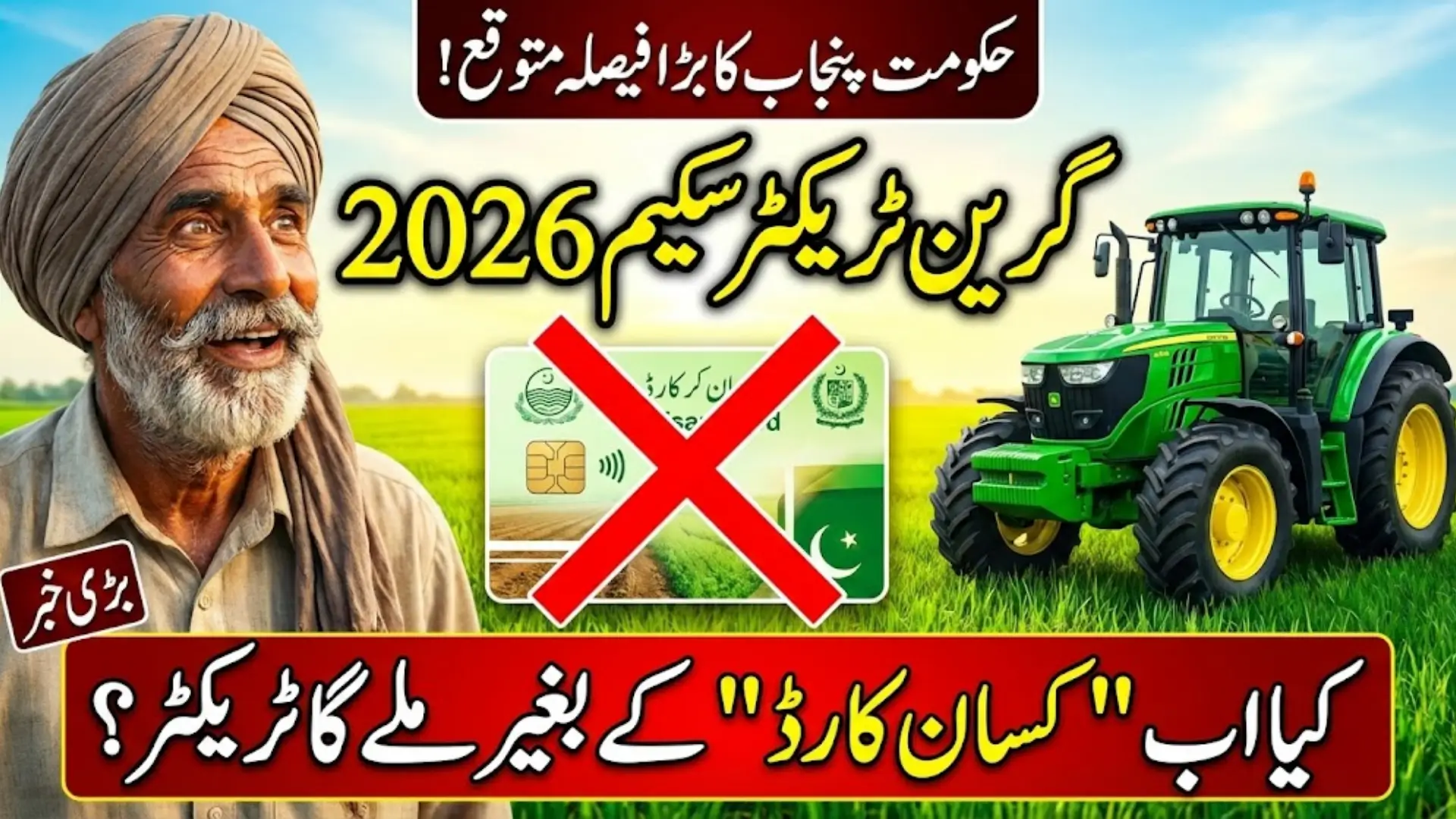
Green Tractor Scheme Phase 3 2026
Green Tractor Scheme Phase 3 2026 Across Punjab, farmers are once again discussing the Green Tractor Scheme, but this time the conversation feels different. In villages, tehsils, and agriculture offices, one question keeps coming up: can farmers apply for Green Tractor Scheme Phase 3 in 2026 without a Kisan Card? For many, this question is not about convenience; it is about long-overdue access to a government scheme that never fully reached the grassroots.
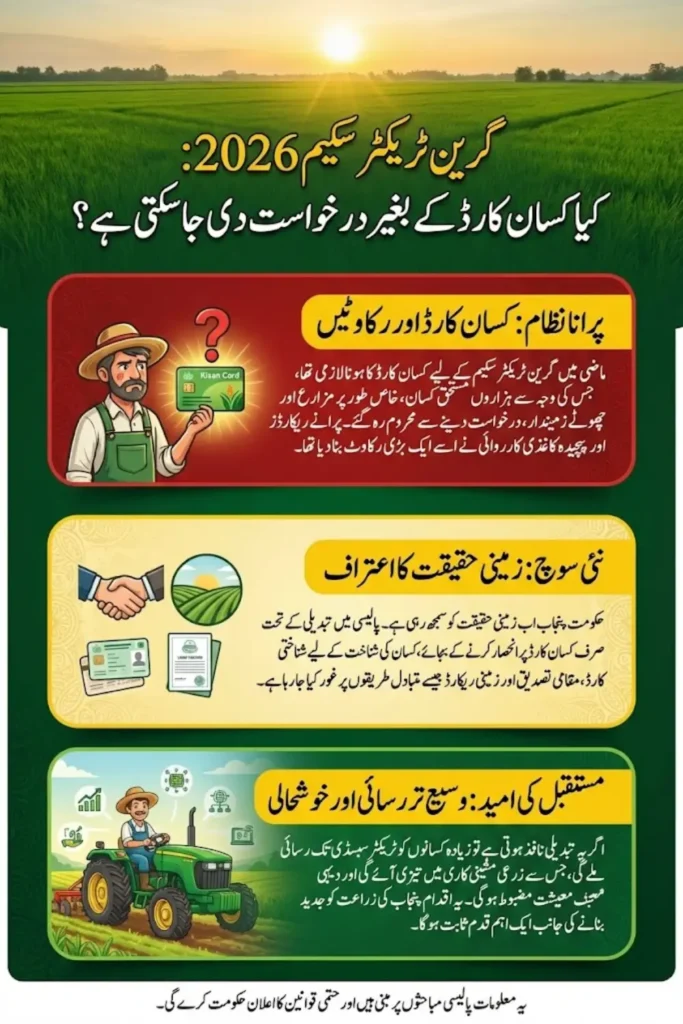
Over the years, the Green Tractor Scheme helped many farmers, but it also left thousands behind due to documentation barriers. Now, with Phase 3 expected in 2026, signals from policy discussions suggest that the government may finally adjust the rules to reflect real farming conditions in Punjab.
You Can Also Read: Parvaaz Psdf Org Pk Registration Portal
A Policy Shift That Reflects Ground Reality
In earlier phases, the government relied heavily on the Kisan Card to verify farmers and distribute subsidies. On paper, this system looked efficient. On the ground, however, it failed to account for outdated land records, informal tenancy, and slow digital updates that are common in rural Pakistan.
Phase 3 appears to be designed as a corrective step. Instead of focusing only on paperwork, policymakers are now discussing identity-based and field-level verification, which could allow genuine farmers to apply even if they do not hold a Kisan Card. This change is not about relaxing standards but about correcting an imbalance that excluded deserving applicants.
You Can Also Read: Vivo Y500i Launch Details
Why Phase 3 Is Creating So Much Interest Among Farmers
The attention around Phase 3 is unusually high because it directly addresses a long-standing grievance. Farmers who cultivate land but do not officially own it were unable to benefit earlier, despite contributing to agricultural output.
From discussions with local agriculture staff and farmer groups, it is clear that expectations are rising because:
- Tenant farmers may finally become eligible
- Small landholders could avoid complex registration delays
- Rural applicants may not be blocked due to missing digital records
- Verification may become more practical and localized
This level of interest shows that Phase 3 is being seen as more than just another subsidy round.
You Can Also Read: PM Laptop Scheme 2026 Online Registration
Purpose of the Green Tractor Scheme Revisited
The Green Tractor Scheme was introduced to modernize Punjab’s agriculture and reduce dependency on outdated manual practices. Tractors were subsidized so that farmers could increase productivity without taking heavy loans from private lenders.
The long-term goals of the scheme include:
- Faster land preparation and sowing cycles
- Reduced labor shortages during peak seasons
- Improved crop yield and efficiency
- Stronger rural income stability
While these objectives remain unchanged, Phase 3 aims to make access fairer.
You Can Also Read: Green Tractor Scheme 2026
How the Kisan Card Became a Barrier Instead of a Solution
The Kisan Card was meant to ensure transparency, but it unintentionally excluded a large section of farmers. Many applicants were rejected not because they were ineligible, but because their records did not match digital databases.
Common problems faced by farmers included:
- Land records not updated for years
- Tenancy agreements not officially registered
- Delays in verification from multiple departments
- Lack of guidance during the registration process
These issues forced the government to reconsider whether one card should decide eligibility for an entire province.
You Can Also Read: eBiz Portal Login For Punjab Scheme
Government Thinking Behind Flexible Eligibility in 2026
According to policy discussions, the government now recognizes that documentation alone does not define a farmer. Phase 3 is expected to introduce flexibility while maintaining accountability through cross-verification systems.
Instead of relying on a single source, eligibility may be confirmed using multiple data points. This approach reduces rejection errors and improves trust between farmers and the government.
How Farmers May Apply Without a Kisan Card in Phase 3
Although official rules are yet to be announced, several alternative verification methods are under serious consideration. These options aim to include farmers who were previously excluded without weakening oversight.
Possible eligibility pathways include:
- CNIC-based farmer identification
- Verification through local agriculture offices
- Land lease or tenancy proof
- Union council or tehsil-level confirmation
This multi-path system can help bridge the gap between policy and reality.
Digital Verification Systems Likely to Replace Card Dependency
Punjab’s agriculture sector is gradually moving toward integrated digital records. Instead of depending on a physical card, Phase 3 may rely on linked databases that verify farmer identity through CNIC and local records.
Expected digital measures include:
- CNIC-linked agriculture profiles
- Cross-checking with land and revenue departments
- Temporary digital farmer IDs for applicants
These systems reduce dependency on a single document while improving monitoring.
Registration Methods Being Planned for Wider Access
Another major improvement expected in Phase 3 is the availability of multiple registration channels. This is important because not all farmers have access to smartphones or stable internet.
Registration options under discussion include:
- Tehsil agriculture offices
- Union council-based verification desks
- Online self-registration portals
- Temporary registration camps in rural areas
This approach recognizes Pakistan’s digital divide and ensures fair access.
Farmers Most Likely to Benefit From Phase 3
Phase 3 is expected to focus more on inclusion rather than expansion. Instead of reaching new areas only, the scheme may prioritize farmers who were previously excluded.
Priority may be given to:
- Small and medium landholders
- Tenant and sharecrop farmers
- Farmers from underdeveloped districts
- Applicants rejected in earlier phases
This focus supports balanced agricultural growth.
Expected Subsidy Structure in Phase 3
While eligibility rules may change, the subsidy mechanism is expected to remain structured and disciplined. The government aims to maintain transparency while expanding access.
Expected Subsidy Overview
| Aspect | Expected Details |
|---|---|
| Subsidy Type | Fixed percentage reduction on tractor price |
| Payment Option | Government-supported installment plans |
| Manufacturers | Approved tractor companies only |
| Monitoring | CNIC-linked verification and tracking |
Farmers will still need to meet verification standards, even without a Kisan Card.
Transparency Measures to Prevent Misuse
Relaxing eligibility does not mean relaxing control. The government is expected to introduce stronger monitoring tools to prevent misuse of subsidies.
Likely measures include:
- CNIC-based subsidy tracking
- Digital agriculture record integration
- Cross-verification across departments
These steps help maintain accountability.
Impact of Removing Mandatory Kisan Card Requirement
If implemented properly, allowing applications without a Kisan Card can significantly change how farmers interact with government schemes. More farmers participating means faster mechanization and better crop cycles.
The broader impact may include:
- Higher farmer participation
- Improved trust in government programs
- Stronger rural economic activity
- Faster adoption of modern farming tools
This shift reflects a more practical policy mindset.
What Farmers Should Do Before Phase 3 Launch
Even with relaxed rules, preparation remains essential. Farmers should start organizing documents and stay connected with local agriculture offices.
Key preparation steps include:
- Keeping CNIC valid and updated
- Collecting land or tenancy proof
- Monitoring official Punjab agriculture updates
- Seeking guidance from local officials
Early preparation can reduce application delays.
Final Thoughts
The possibility of Green Tractor Scheme Phase 3 2026 without mandatory Kisan Card represents a significant evolution in Punjab’s agricultural policy. It shows that the government is learning from past mistakes and adapting schemes to real farming conditions rather than ideal paperwork scenarios.
If implemented transparently, Phase 3 can bring genuine relief to farmers, expand access to subsidies, and strengthen Punjab’s agricultural foundation for years to come. Farmers are advised to remain informed and prepare ahead of the official launch.