

Employee Allowances
Employee Allowances For employees working in special courts and tribunals across Pakistan, the last few months have been extremely stressful. Judicial and utility allowances are a crucial part of their monthly income, especially for staff members who fall in middle- and lower-income categories. When these allowances were suddenly stopped through official orders, many families struggled to manage routine expenses such as rent, school fees, medical costs, and utility bills. At a time when inflation is already squeezing household budgets, this decision added to the anxiety of thousands of workers.
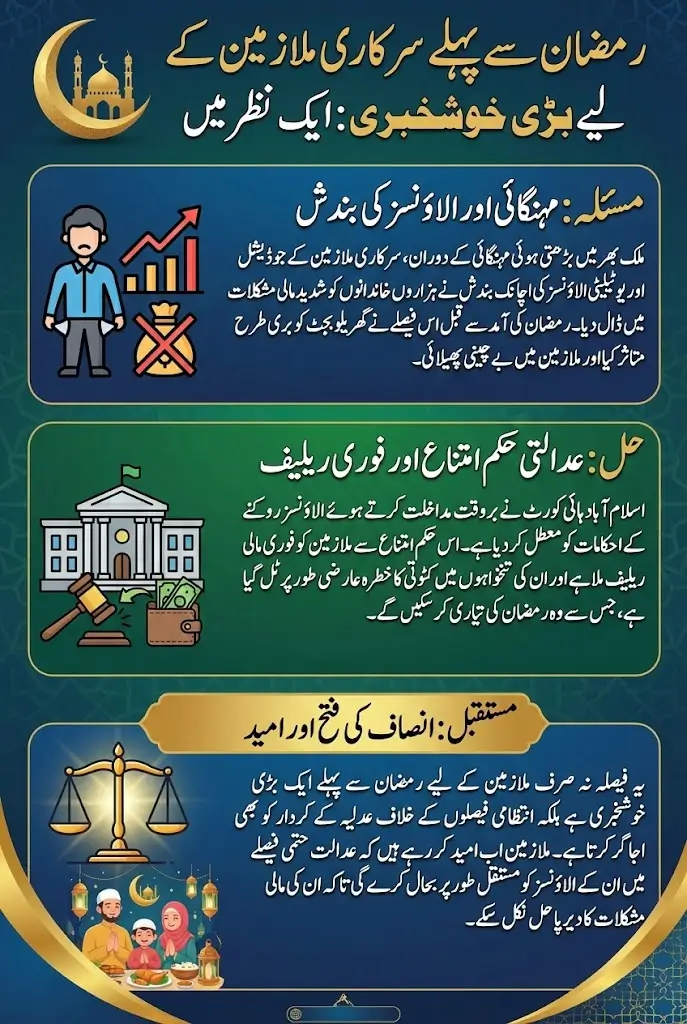
Just ahead of Ramadan, the Islamabad High Court has provided much-needed relief. The court’s decision to suspend the orders stopping these allowances is being widely welcomed by employees. It is not only a legal development but also a human one, as it directly impacts livelihoods during a sensitive financial period for Pakistani families.
You Can Also Read: Punjab Ration Card Scheme
Background of the Allowance Issue
Judicial and utility allowances are paid to employees of special courts and tribunals in recognition of the nature of their work. These employees deal with sensitive cases, strict schedules, and additional responsibilities, which is why such allowances exist. For years, these payments were considered a settled part of their service structure.
The problem started when instructions were issued by financial authorities to stop these allowances. Employees were neither consulted nor clearly informed about the reasons. Many staff members came to work every day unsure about their future income, which naturally affected morale and productivity. From what has been observed, most employees were not asking for extra benefits; they were simply demanding the continuation of what they had been lawfully receiving.
Key issues faced by employees included:
- Sudden stoppage of allowances without prior notice
- Increased financial pressure due to rising inflation
- Lack of official explanation or timeline for resolution
You Can Also Read: Punjabs New Poverty Relief Program to Offer Rs 45,000 Monthly
Islamabad High Court’s Timely Intervention
After multiple petitions were filed, the matter reached the Islamabad High Court. Justice Arbab Muhammad Tahir took up the case and issued a clear interim order that changed the direction of the issue. The court suspended the orders that had stopped the allowances, offering immediate relief to affected employees.
From a journalist’s perspective, this intervention shows how courts often act as protectors when administrative decisions negatively affect ordinary workers. The timing of this order is particularly important because it comes just before Ramadan, when household spending naturally increases. For many families, this decision means they can prepare for the holy month with less financial fear.
The court’s action has:
- Temporarily restored financial stability for employees
- Ensured that the issue will be decided after proper hearing
- Sent a strong signal about fairness and due process
You Can Also Read: Ramadan Nighaban Package 2026 in Punjab
Orders Suspended by the Court
The Islamabad High Court specifically suspended the orders issued by the Accountant General’s Office and the Ministry of Finance. These instructions, dated September 5 and September 15, 2025, were responsible for halting the payment of allowances. By suspending them, the court ensured that these orders cannot be enforced until a final decision is made.
This suspension does not mean the case is over, but it does protect employees from immediate financial harm. It also places responsibility on the concerned departments to justify their decisions before the court rather than acting unilaterally.
| Authority | Order Date | Court Status |
|---|---|---|
| Accountant General’s Office | September 5, 2025 | Suspended |
| Ministry of Finance | September 15, 2025 | Suspended |
Federal Institutions Directed to Respond
The court did not limit its action to suspending orders. Notices were issued to major federal institutions, asking them to submit their replies within two weeks. This step ensures transparency and allows the court to examine all viewpoints before issuing a final ruling.
The institutions asked to respond include:
- Federal Government
- Ministry of Finance
- Controller General of Accounts
- Accountant General of Pakistan
By involving all relevant departments, the court has made it clear that decisions affecting employees’ livelihoods cannot be taken lightly.
You Can Also Read: CM Punjab Laptop Scheme 2026 Phase-II:
Unequal Treatment of Employees Comes to Light
One of the most concerning points raised during the hearing was discrimination among employees. According to the petitioners’ lawyer, those who approached the court continued receiving their allowances, while others were deprived of them. This created a clear divide among staff members performing the same duties.
Such unequal treatment raised serious legal and moral questions. Many employees felt they were being punished simply because they had not yet filed a petition. The court took this matter seriously, as equality before the law is a fundamental principle.
You Can Also Read: Apna Khait Apna Rozgaar Program For Farmers
Legal Arguments Presented on Behalf of Employees
Advocate Muhammad Asif Gujjar represented the petitioners and presented strong arguments before the court. He emphasized that judicial and utility allowances are not temporary favors but established service benefits. Stopping them without lawful justification, he argued, goes against principles of administrative fairness.
His arguments focused on:
- The legal status of allowances as part of service benefits
- Discriminatory continuation of payments for select employees
- Financial hardship caused to families due to abrupt stoppage
These points played a significant role in persuading the court to grant interim relief.
You Can Also Read: Apni Zameen Apna Ghr For Free 3 Marla Plot
Support from Other High Court Benches
This issue is not confined to Islamabad alone. The Multan and Bahawalpur benches of the Lahore High Court had already suspended similar orders earlier. This consistency across different courts strengthens the case of employees and shows that the judiciary is aligned on this matter.
When multiple courts take the same position, it sends a strong message that the issue is systemic and requires serious attention from the government.
You Can Also Read: Safe City New E-Challan SMS System
More Employees Step Forward
Employees from the Customs Appellate Tribunal, including Muhammad Sufyan and others, have also approached the court. This shows that the problem affects a wide range of institutions and is not limited to one department or city.
As more employees come forward, the case gains strength and reflects collective concern rather than isolated complaints.
Next Hearing and What Employees Expect
The next hearing has been scheduled for February 9. By then, all concerned departments are expected to submit their written replies. Employees are hopeful that the court will issue a permanent decision in their favor, ensuring long-term stability rather than temporary relief.
Until that date, the suspended orders provide breathing space for families who were worried about meeting Ramadan expenses.
You Can Also Read: Preparations Have Been Made to Change School
Why This Decision Matters Before Ramadan
Ramadan is a time of spiritual focus, but it also brings additional financial responsibilities for Pakistani households. Food expenses increase, utility usage goes up, and many families also plan charity and zakat payments. Restoring allowances before Ramadan helps employees manage these responsibilities with dignity.
From ground-level observation, this decision has lifted a heavy burden from many households that were unsure how they would manage the coming month.
A Strong Message on Employee Rights
Beyond allowances, this case highlights an important principle: service benefits cannot be withdrawn without lawful procedure. The Islamabad High Court’s intervention reinforces trust in the justice system and reminds government departments of their responsibility toward employees.
For now, employees of special courts and tribunals can feel reassured. As Ramadan approaches, they await the next hearing with hope that fairness and stability will prevail.
You Can Also Read: Punjab Chief Minister Approves Rs 47 Billion Ramadan